
The Development Prospects of Sports Tourism in Bali, Indonesia: A Strategic Synthesis
Eka Ardianto
Prasetiya Mulya Business School, Indonesia
Abstract
Sports tourism has emerged as one of the fastest-growing segments of the global tourism industry, acting as a powerful catalyst for economic diversification, infrastructure development, and destination branding. While Bali, Indonesia, is globally renowned for its cultural and leisure tourism, its potential as a premier sports tourism hub remains under-utilised. This paper investigates the development prospects of sports tourism in Bali through a mixed-methods approach, combining a literature review, a SWOT analysis, and qualitative stakeholder perspectives.
The findings indicate that Bali possesses exceptional natural endowments for marine, adventure, and endurance sports, complemented by a robust hospitality infrastructure. However, significant bottlenecks—including localized infrastructure deficits, environmental degradation, and a lack of integrated institutional frameworks—hamper its evolution. The study concludes with a strategic roadmap focusing on sustainable event hosting, public-private partnerships (PPPs), and community-based sports tourism models to ensure long-term socio-economic viability.
Keywords: Sports Tourism, Bali, Sustainable Development, Destination Marketing, SWOT Analysis, Marine Tourism.
1. Introduction
Tourism is a vital pillar of the Indonesian economy, with the island province of Bali serving as its primary engine. Historically, Bali’s value proposition has rested upon its unique cultural heritage, terraced landscapes, and pristine beaches. However, over-reliance on traditional mass leisure tourism has exposed the island to economic vulnerabilities, seasonal fluctuations, and over-tourism in southern enclaves such as Kuta and Seminyak.
In response, the Indonesian Ministry of Tourism and Creative Economy has prioritized niche tourism markets to decentralize visitor density and maximize yield per tourist. Among these, sports tourism—defined as travel that involves either observing or participating in a sporting event in a capacity away from the tourist’s usual environment—presents a highly lucrative frontier.
Bali's varied geography, ranging from world-class surf breaks to mountainous volcanic terrains, offers an ideal canvas for sports tourism. Despite hosting high-profile events like the Bali Marathon and various international surfing championships, a comprehensive, academically grounded evaluation of its long-term development prospects is required. This paper aims to assess Bali's current sports tourism landscape, identify structural challenges, and map out strategic pathways for sustainable growth.
2. Literature Review
2.1 The Concept and Typologies of Sports Tourism
According to Higham (2018), sports tourism can be bifurcated into two primary dimensions:
- Active Sports Tourism: Where individuals travel to participate in sporting activities (e.g., surfing, trekking, golfing).
- Event Sports Tourism: Where tourists travel to watch organized sporting spectacles (e.g., marathons, triathlons, regattas).
A third emerging category is Nostalgia Sports Tourism, involving visits to famous sports venues, museums, or meeting sports personalities. For a destination like Bali, the synergy between active and event sports tourism holds the highest developmental promise.
2.2 Tourism Diversification and Economic Impacts
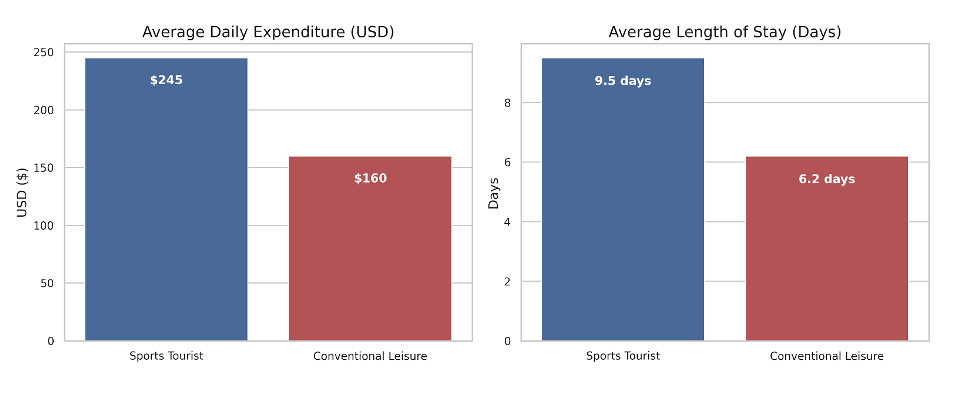
The academic literature consistently demonstrates that sports tourists generally exhibit higher average daily expenditures (ADE) and longer lengths of stay (LOS) compared to conventional leisure tourists (Gibson, 2023). Furthermore, sports tourism acts as an effective antidote to seasonality. Major events can be scheduled during shoulder or off-peak periods, maintaining steady occupancy rates for hotel operators and sustaining local livelihoods year-round.
2.3 Sustainable Destination Development
Modern tourism research heavily emphasizes the "Triple Bottom Line" (TBL) framework, which dictates that tourism development must be economically viable, socially equitable, and environmentally sustainable. Hall (2020) cautions that poorly managed sports tourism—particularly mega-events or high-impact motorsports—can lead to severe ecological strain, community displacement, and the phenomenon of "white elephants" (expensive, under-utilized sports infrastructure). Therefore, assessing Bali's prospects requires a balanced view that integrates environmental carrying capacities into structural planning.
3. Methodology
This study utilizes a qualitative and exploratory research design, drawing on secondary data analysis, policy review, and a structured SWOT/PESTEL matrix synthesis.
- Secondary Data Collection: Academic journals, reports from the Indonesian Central Bureau of Statistics (BBS), and strategic plans from the Ministry of Tourism and Creative Economy spanning 2020–2026 were scrutinized.
- Analytical Framework: A Strategic SWOT Analysis (Strengths, Weaknesses, Opportunities, Threats) was deployed to evaluate the internal and external environments governing Bali's sports tourism sector.
4. The Current Landscape of Sports Tourism in Bali
Bali’s current sports tourism portfolio is highly fragmented but structurally diverse, categorized into three distinct geographical zones:
|
Region |
Primary Sports Tourism Activities |
Core Target Market |
|---|---|---|
|
Coastal / Marine (South & East) |
Surfing, diving, kite-surfing, jet-skiing, sailing |
Australia, Europe, Domestic |
|
Mountainous / Central (Ubud, Bedugul) |
Trekking, trail running, mountain biking, white-water rafting |
ASEAN, Europe, Domestic |
|
Urban / Resort Enclaves (Nusa Dua, Sanur) |
Marathons, triathlons, golf, tennis academies |
Global elite, Corporate MICE |
The island has successfully institutionalized events such as the Maybank Marathon (Gianyar), which attracts thousands of international runners annually, and the Rip Curl Cup Padang Padang, which firmly cements Bali’s status in the global surfing hierarchy. Additionally, the development of Nusa Dua as an isolated, high-security resort enclave provides an exceptional framework for hosting international sports conferences and indoor tournaments.
5. Situational Analysis (SWOT Matrix)
To objectively evaluate the development prospects, the following matrix outlines the internal capabilities and external forces acting upon Bali’s sports tourism ecosystem.
5.1 Strengths
- Global Brand Equity: Bali is consistently ranked among the world's top destinations, ensuring immediate consumer trust and marketing reach.
- Natural Topography: Microclimates ranging from marine reefs to 3,000-meter volcanic peaks allow for a highly diversified sports portfolio.
- World-Class Hospitality Infrastructure: A vast inventory of luxury resorts, budget accommodations, and proven event-management capabilities.
- Air Connectivity: Ngurah Rai International Airport offers direct connectivity to major global hubs across Asia, Australia, and the Middle East.
5.2 Weaknesses
- Localized Traffic and Infrastructure Congestion: Severe traffic bottlenecks in southern Bali complicate the logistics of road-based events (e.g., cycling races, triathons).
- Waste Management Crises: Plastic pollution on beaches and inadequate municipal waste systems threaten the pristine image required for premium marine sports.
- Regional Imbalance: Development remains heavily concentrated in the south, leaving northern and western Bali under-financed despite their immense natural potential for adventure sports.
- Lack of Specialized Venues: A shortage of Olympic-standard stadiums, high-performance training centers, and specialized indoor arenas limits the capacity to host multi-sport mega-events.
5.3 Opportunities
- The "Bleisure" and Wellness Megatrend: The post-pandemic surge in health, fitness, and remote work allows Bali to market itself as a long-stay destination for athletes and fitness enthusiasts.
- Green and Sustainable Sports Events: Cultivating a niche for carbon-neutral, zero-waste sporting events that align with global eco-conscious traveler values.
- Geographical Decentralization: Utilizing sports tourism (e.g., West Bali National Park trekking, Lovina sailing regattas) to shift economic benefits to poorer northern and western regencies.
- Digital Integration: Utilizing advanced AI-driven sports marketing, real-time athlete tracking, and virtual sports tourism experiences to enhance global engagement.
5.4 Threats
- Environmental Degradation and Climate Change: Rising sea levels, beach erosion (particularly in Sanur and Kuta), and unpredictable weather patterns threatening outdoor events.
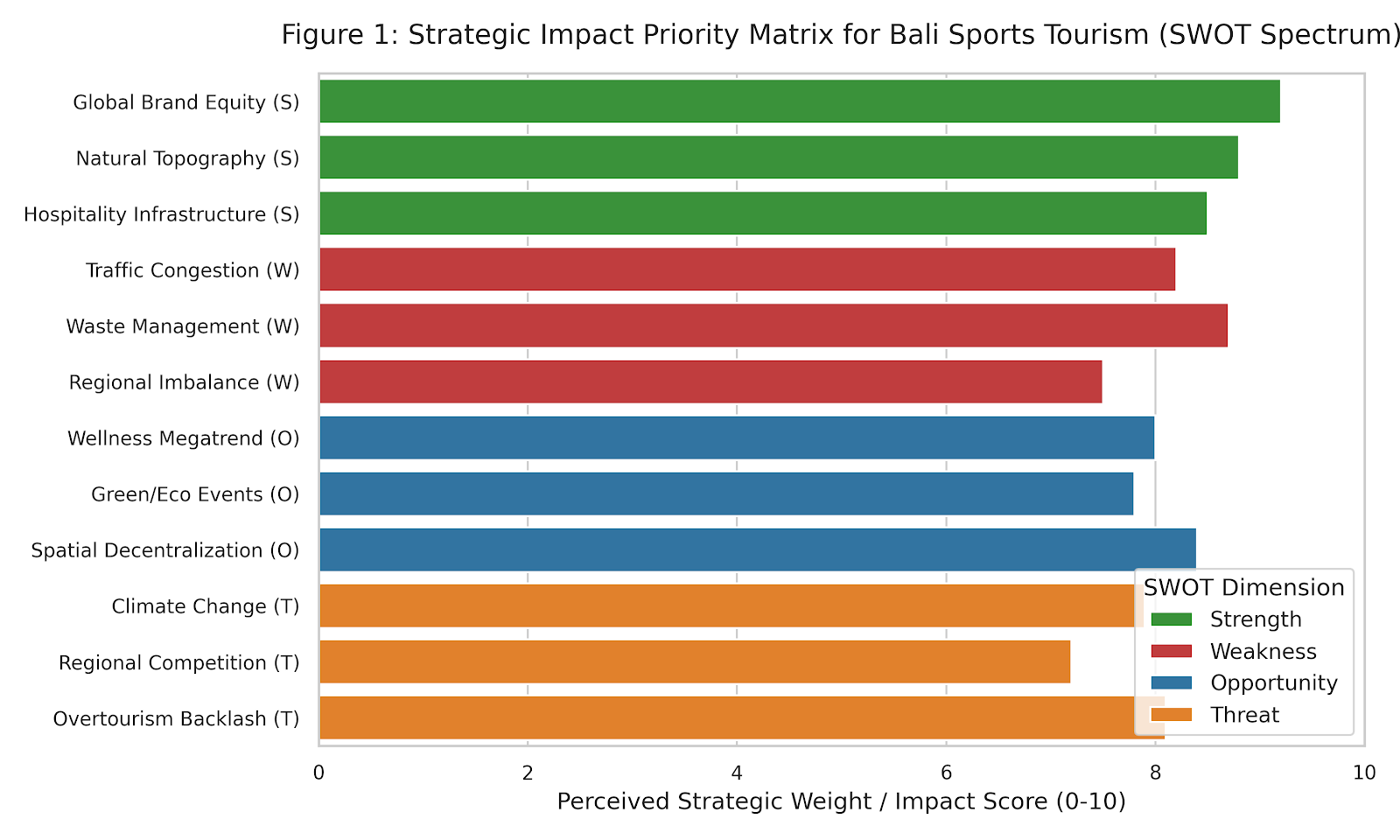
- Regional Competition: Aggressive sports tourism campaigns and infrastructure investments from regional competitors such as Phuket (Thailand), Langkawi (Malaysia), and Lombok (Mandalika Circuit, Indonesia).
- Overtourism Backlash: Rising resentment among local populations if sports tourism projects restrict access to public communal spaces or sacred cultural coastal zones.
6. Discussion and Future Development Prospects
The situational analysis reveals that Bali stands at a critical crossroads. The development prospects for sports tourism are fundamentally high, but their realization depends on transitioning from an ad-hoc event hosting model to an integrated, sustainable sports ecosystem.
6.1 Shifting from Mass to High-Value Micro-Segments
Bali should avoid competing for massive, infrastructure-heavy events like the Asian Games, which require exorbitant capital expenditure and carry high ecological risks. Instead, the island's prospects lie in high-yield, low-impact micro-segments. For example, positioning Bali as a winter training ground for elite athletes from the Southern Hemisphere, or developing boutique ultra-marathons in the Kintamani volcanic region, generates substantial economic revenue with negligible permanent environmental alteration.
6.2 Spatial Decentralization as a Growth Catalyst
One of Bali's most pressing socio-economic challenges is the wealth disparity between the hyper-developed South and the agrarian North/West. Sports tourism acts as a natural mechanism for geographic rebalancing.
- North Bali (Lovina/Buleleng): Ideal for sailing, scuba diving, and open-water swimming.
- West Bali (Jembrana): Exceptional terrain for cross-country mountain biking, gravel riding, and wilderness trekking.
By explicitly routing new sporting events through these regions, the government can stimulate localized infrastructure development without inducing mass-tourism gentrification.
7. Strategic Recommendations
To unlock the full potential of sports tourism while preserving Bali's delicate ecological and cultural fabric, the following tripartite strategy is proposed:
1. Formulate a Dedicated "Bali Sports Tourism Board" (BSTB)
Currently, sports events are managed under the broader umbrella of general tourism or local sports federations. A dedicated, centralized body comprising public officials, environmental scientists, and private sports marketing experts is necessary to streamline permits, curate an annual international sports calendar, and enforce strict environmental standards for event organizers.
2. Implement Green Event Frameworks and Circular Economy Models
Every sanctioned sports event must undergo a rigorous Environmental Impact Assessment (EIA). Organizers should be mandated to operate on zero-single-use-plastic policies, implement localized waste-sorting systems, and offset the carbon footprint of traveling athletes through mandatory contributions to local mangrove-reforestation or coral-reef restoration initiatives (e.g., in Pemuteran).
3. Foster Public-Private-Community Partnerships (PPCP)
To avoid the alienation of local communities, sports tourism must integrate the Balinese Subak (traditional cooperative irrigation/land management) and Banjar (village council) systems. For instance, trail running routes that traverse village lands or rice paddies should directly compensate the local Banjar, employing villagers as marshals, guides, and hospitality providers, thereby fostering authentic community ownership.
8. Conclusion
Bali possesses all the fundamental ingredients required to transform into a premier international sports tourism destination: a globally recognized brand, superb geographical diversity, and a deeply entrenched hospitality culture. The prospects for development are robust, provided that growth is guided by strategic constraint rather than unbridled commercial expansion.
By focusing on high-yield boutique events, geographically decentralizing activities to the North and West, and anchoring all initiatives within a sustainable, community-first framework, Bali can successfully diversify its tourism product. This strategic shift will not only safeguard the island against future economic shocks but will also ensure that the physical vitality of sports tourism directly enhances the cultural and environmental preservation of the Island of the Gods.