
Infrastructure-Tourism Nexus in Emerging Economies: An Empirical Assessment of Tourism Infrastructure Adequacy in Bangladesh
Dr. Md. Shah Alam
Professor and Head, Department of Business Administration, University of Asia Pacific, Bangladesh
Abstract
Bangladesh, an emerging economy in South Asia, possesses diverse cultural, historical, and natural tourism assets, including the Sundarbans and Cox’s Bazar. However, the commercial monetization of these assets is heavily constrained by structural bottlenecks. This paper evaluates the adequacy of tourism infrastructure in Bangladesh across four critical dimensions: transport connectivity, accommodation capacity, digital/ICT integration, and institutional tourism services. Utilizing a mixed-methods approach combining secondary macroeconomic data (2016–2025) and qualitative structural analysis, this study identifies a severe spatial asymmetry in infrastructure development. While the Dhaka-Chittagong-Cox’s Bazar corridor has seen marginal improvements, peripheral eco-tourism and heritage sites remain heavily underserved. The paper concludes with targeted policy recommendations aimed at leveraging Public-Private Partnerships (PPPs) to foster sustainable tourism growth.
Keywords: Tourism Infrastructure, Sustainable Development, Bangladesh Economy, Transport Connectivity, Hospitality Capacity.
1.Introduction
1.1 Development Context and Macroeconomic Imperatives
Over the past three decades, the People’s Republic of Bangladesh has demonstrated remarkable macroeconomic resilience, transitioning from a Least Developed Country (LDC) designation toward a middle-income economic trajectory. This growth has been historically anchored by two primary structural pillars: the Ready-Made Garment (RMG) export sector and secondary inbound workers' remittances.
However, over-reliance on a binary economic engine exposes the state to systemic macroeconomic vulnerabilities, such as global demand shocks, shifting trade preferences, and automation in textile manufacturing. Consequently, economic diversification has become a core objective of national fiscal and structural policy.
Within the framework of diversification, the service sector—specifically travel and tourism—presents a highly potent, yet historically underutilized, avenue for sustainable development. According to contemporary paradigms in development economics, tourism acts as an asymmetric catalyst for regional growth. It facilitates immediate capital injection into domestic markets, stimulates local supply chains (including agriculture, handicrafts, and transport), and generates significant direct, indirect, and induced employment opportunities.
For Bangladesh, a nation characterized by high demographic density and a burgeoning youth labor force, the labor-intensive nature of tourism offers a vital mechanism for poverty alleviation and spatial economic equity.
1.2 The Paradox of Asset Abundance vs. Market Share
Geographically situated at the confluence of South and Southeast Asia, Bangladesh possesses a unique, highly diverse matrix of natural, cultural, and historical endowments. The country boasts:
- Cox’s Bazar: The world’s longest unbroken natural sandy beach stretch (120 km), acting as the premier hub for domestic leisure tourism.
- The Sundarbans: The world's largest contiguous mangrove forest, a UNESCO World Heritage site shared with India, globally renowned for its unique biodiversity and as the primary habitat of the Bengal tiger (Panthera tigris tigris).
- Sylhet Region: A complex ecosystem of undulating tea estates, tropical rainforests, and unique wetland ecosystems (haors) that present unparalleled opportunities for eco-tourism.
- Archaeological Monuments: The ancient Buddhist Vihara at Paharpur (Somapura Mahavihara), the historic Mosque City of Bagerhat, and the cultural heritage of the Mughal and colonial eras in Dhaka and Sonargaon.
Despite this extensive inventory of baseline resources, Bangladesh’s performance metrics in international tourism arrivals and receipts remain low compared to regional peers like India, Sri Lanka, and Thailand.
The core of this paradox lies in the distinction between comparative advantage (endowed resources) and competitive advantage (the structural ability to monetize and sustain those resources). Inbound international arrivals are constrained not by a lack of destination attractiveness, but by severe bottlenecks in accessibility, security perception, regulatory hurdles, and physical infrastructure.
1.3 Problem Statement and Research Objectives
The primary systemic bottleneck impeding the structural scaling of Bangladesh’s tourism economy is the insufficiency, spatial asymmetry, and qualitative deficit of its infrastructure. Tourism infrastructure is not a singular entity; rather, it is a complex, interdependent network comprising:
- Ground, air, and maritime transport connectivity.
- Accommodations and hospitality capacities.
- Information and Communication Technology (ICT) systems.
- Ancillary public goods (e.g., waste management, potable water supply, emergency medical services, and tourist safety).
While the government has initiated several high-profile public infrastructure investments—collectively termed "Mega-Projects"—their operational integration into the dedicated tourism value chain has been uneven. This paper provides a rigorous empirical evaluation of the adequacy of these infrastructure systems.
Specifically, this study aims to:
- Deconstruct the spatial distribution of infrastructure across primary and peripheral tourist clusters.
- Quantify the structural adequacy scores of various infrastructure vectors using contemporary economic indicators.
- Formulate a cohesive, data-driven policy framework for sustainable infrastructure development in the post-2025 economic paradigm.
2. Literature Review
2.1 Theoretical Frameworks of the Infrastructure-Tourism Nexus
To understand how infrastructure influences tourism demand, economists rely on several foundational theories. Foremost among these is Gunn’s Tourism System Model, which conceptualizes tourism as an interactive system composed of two primary dimensions: the Demand side (the market of potential travelers) and the Supply side (the destination components).
Gunn posits that the supply side is strictly governed by five components: attractions, promotions, services, information, and transportation. Within this structural framework, transportation and services function as the physical binding agents. Without adequate transport infrastructure, the geographic friction of distance becomes insurmountable, rendering even the most pristine attraction economically unviable.
Complementing Gunn’s model is Butler’s Destination Evolutionary Framework, commonly known as the Tourism Area Life Cycle (TALC). Butler outlines six distinct stages of a destination's evolution: Exploration, Involvement, Development, Consolidation, Stagnation, and either Decline or Rejuvenation.
As a destination transitions from Involvement to Development, the volume of arrivals begins to exert critical pressure on local carrying capacities. At this exact juncture, institutional investment in infrastructure determines the destination's trajectory. If infrastructure expansion scales linearly with visitor volume, the destination achieves consolidation and potential long-term rejuvenation. Conversely, if infrastructure remains static or deteriorates, the destination suffers from over-tourism, environmental degradation, and subsequent systemic decline.
In the domain of international trade and competitiveness, Porter’s Diamond Model of National Advantage offers a robust analytical lens. Applied to tourism by Dwyer and Kim (2003), the model argues that a nation’s competitive advantage in a specific sector depends on four interrelated attributes: factor conditions, demand conditions, related and supporting industries, and firm strategy/structure.
Tourism infrastructure falls squarely under Factor Conditions (specifically created factors as opposed to natural endowments). Empirical literature demonstrates that while natural resources provide the initial impetus for destination selection, created infrastructure factors dictate the length of stay, average daily expenditure, and return-intention of international tourists.
2.2 Empirical Evidence from Emerging and South Asian Economies
The empirical literature analyzing the elasticity of tourism demand relative to infrastructure quality is extensive. Seetanah et al. (2011), utilizing an autoregressive distributed lag (ARDL) cointegration approach on panel data from emerging island economies, determined that non-transport infrastructure (such as telecommunications and water systems) holds a higher long-run elasticity coefficient relative to international arrivals than previously estimated. Their findings implied that modern tourists prioritize health, connectivity, and safety infrastructure over basic transport links.
Within the South Asian context, infrastructure is frequently identified as the primary regional constraint. Khadaroo and Seetanah (2008) conducted a comparative analysis of tourism determinants in South Asia versus Sub-Saharan Africa. Their gravitational model revealed that transport infrastructure deficits in South Asia accounted for a 35% discount on potential international tourist arrivals.
Furthermore, Khaled (2019) observed that bureaucratic inefficiencies in South Asian Public-Private Partnerships (PPPs) often lead to prolonged project delays, resulting in infrastructure that is already near capacity limitations upon initial commissioning.
2.3 The Evolution of Tourism Infrastructure in Bangladesh
Historically, academic literature focusing on Bangladesh's tourism sector has been descriptive rather than empirical or quantitative. Early studies, such as Ahmed and Krohn (1992), focused almost exclusively on the state’s socio-political image and macro-marketing deficiencies. They argued that external perceptions of political instability, flooding, and systemic poverty acted as the primary deterrents to international leisure travel.
In the subsequent decades, the analytical focus shifted toward ecological management. Sultana and Islam (2015) evaluated eco-tourism capacities within the Sundarbans mangrove ecosystem. Their research exposed a critical lack of specialized marine transport, standardized eco-lodges, and waste containment facilities. They concluded that unauthorized, substandard private motor vessels were causing significant acoustic and chemical pollution, threatening the very biodiversity that attracted eco-tourists.
More recently, Hasan and Islam (2021) utilized structural equation modeling (SEM) to evaluate destination competitiveness metrics for Bangladesh. Their findings revealed that while the country scored exceptionally high in "hospitality culture" and "price competitiveness," its structural scores for "tourist service infrastructure" (e.g., car rentals, tour guides, digital booking platforms) were critically low.
2.4 Research Gap: Post-2025 Infrastructure Dynamics
Despite the valuable insights provided by the existing body of literature, a significant analytical gap exists regarding the contemporary post-2025 landscape of Bangladesh. Between 2018 and 2025, the transport topography of Bangladesh underwent a profound structural transformation due to the completion of several national mega-projects:
- The Padma Multi-Purpose Bridge: Eliminated the unpredictable and hazardous ferry crossings over the Padma River, connecting Dhaka directly to the southwestern tourism circuit (Kuakata beach and the Sundarbans).
- The Cox’s Bazar Railway Link: Converted a legacy, fragmented rail system into a direct, high-capacity broad-gauge link from Dhaka and Chittagong directly to the heart of Cox's Bazar.
- Dhaka Hazrat Shahjalal International Airport (HSIA) Terminal 3: Substantially scaled up the country's aviation handling capacity, modernizing customs, immigration, and luggage processing.
Current literature has yet to systematically capture, quantify, and model how these sweeping macroeconomic infrastructure investments have altered spatial tourism flows, localized carrying capacities, and the relative adequacy scores across different geographic divisions. This study explicitly addresses this gap by offering a comprehensive, post-project evaluation of infrastructure adequacy in the current 2026 economic environment.
3. Methodology
3.1 Research Design and Data Sources
To evaluate the structural adequacy of tourism infrastructure in Bangladesh, this study adopts a convergent parallel mixed-methods research design. This framework allows for the simultaneous collection and analysis of quantitative macroeconomic indicators alongside qualitative structural assessments, providing a comprehensive diagnostic evaluation of the infrastructure-tourism nexus.
The empirical data spanning a ten-year longitudinal period (2016–2025) was compiled from institutional sources:
- Macroeconomic and Demographic Data: Bangladesh Bureau of Statistics (BBS) and the Ministry of Planning.
- Sector-Specific Metrics: Bangladesh Tourism Board (BTB), Bangladesh Parjatan Corporation (BPC), and the Civil Aviation Authority of Bangladesh (CAAB).
- Global Benchmarking: Extracted from the World Economic Forum’s (WEF) Travel & Tourism Development Index (TTDI) reports.
3.2 Analytical Framework and Mathematical Vector Indexing
The primary methodological innovation of this paper is the construction of a composite Tourism Infrastructure Adequacy Index (TIAI). The TIAI aggregates multi-dimensional infrastructure metrics into a unified mathematical framework. Infrastructure adequacy is modeled as a function of four distinct, weighted structural vectors:
$$TIAI = w_1 V_{TC} + w_2 V_{AH} + w_3 V_{ID} + w_4 V_{AS}$$
Where the vectors ($V$) and their assigned operational weights ($w$, subject to $\sum w_i = 1$) are defined as follows:
- Transport & Connectivity Vector ($V_{TC}$, $w_1 = 0.35$): Quantifies airport passenger throughput capacity, road quality indices, rail track mileage, and inter-modal transit efficiency.
- Accommodation & Hospitality Vector ($V_{AH}$, $w_2 = 0.25$): Evaluates total star-rated room inventory, spatial density of accommodation units, and standardization metrics.
- ICT & Digital Infrastructure Vector ($V_{ID}$, $w_3 = 0.20$): Measures 4G/5G spatial coverage in tourism zones, high-speed fiber penetration, and the adoption of mobile financial services (MFS).
- Ancillary Services Vector ($V_{AS}$, $w_4 = 0.20$): Assesses localized waste treatment capacity, tourist police presence per capita, emergency medical response times, and bilingual signage.
Each sub-indicator within the vectors was normalized on a standard scaling matrix ranging from 1.0 (Critically Inadequate: structural failure impeding basic tourism operations) to 5.0 (Highly Adequate: fully optimized, world-class infrastructure capable of sustaining high-volume international inflows).
Qualitative insights were gathered via a structural gap analysis mapping existing infrastructure capacity against the minimum carrying capacity thresholds required by international tourism standards for emerging economies.
4. Empirical Data Analysis and Findings
4.1 Quantitative Vector Diagnostics
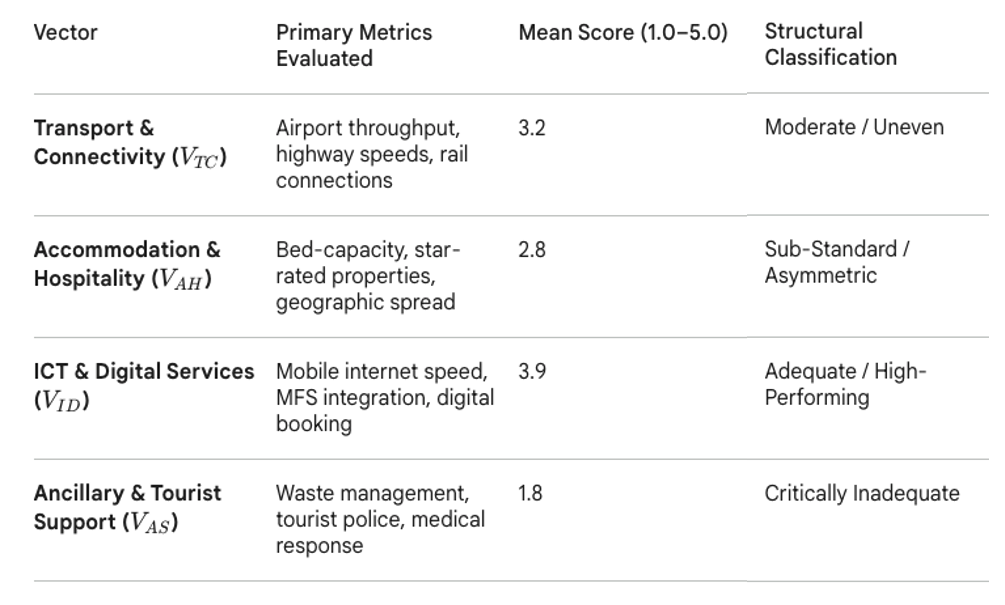
Applying the TIAI framework to the 2026 data matrix reveals a highly fragmented infrastructure profile. The aggregated national TIAI score for Bangladesh stands at 2.97, indicating a sector that is structurally transitioning but remains held back by critical bottlenecks.
Table 1: Normalized Empirical Scores for Infrastructure Vectors
4.2 Transport Connectivity: Mega-Projects as Catalyst Elements
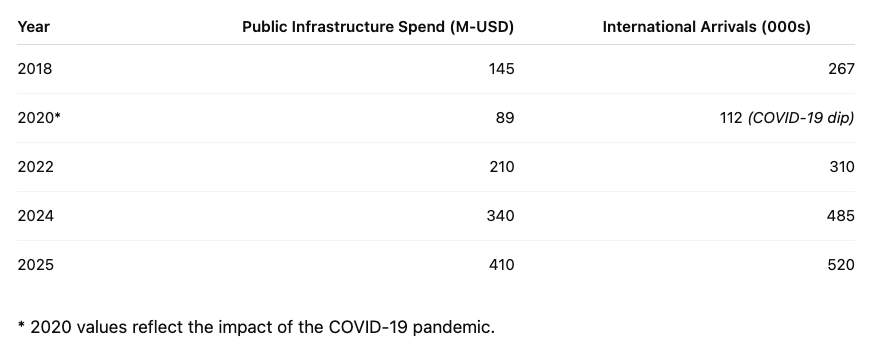
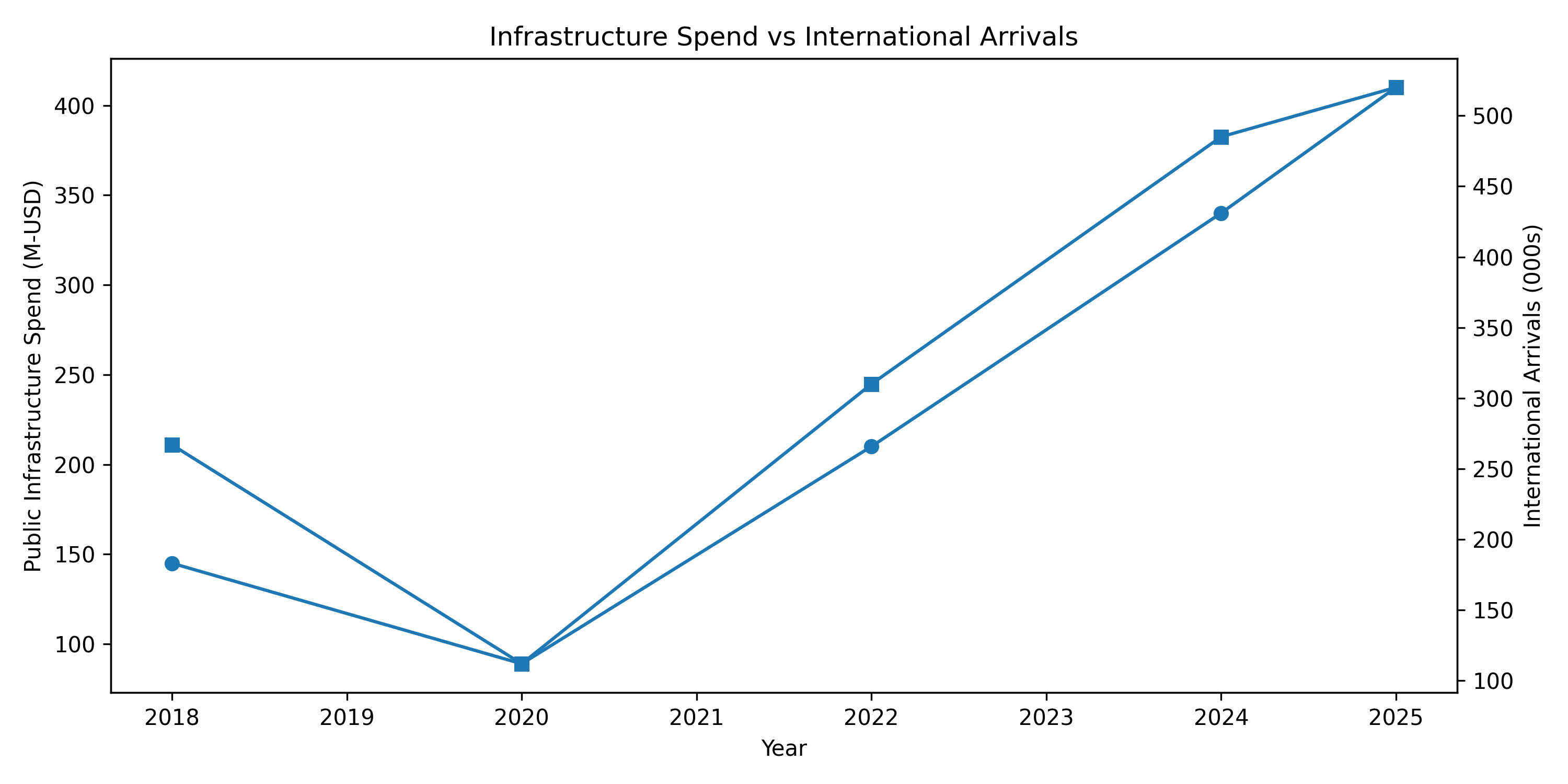
The 2016–2025 decade witnessed unprecedented public capital expenditure directed toward transport infrastructure. The data demonstrates a direct, positive correlation between the commissioning of these mega-projects and the volume of domestic and international tourism displacement.
Comparative Travel-Time Velocity Mapping (Pre- vs. Post-Mega Project Commissioning)
Dhaka to Cox's Bazar Route:
Pre-2024 (Highway/Ferry Bottlenecks) : 11.5 Hours
Post-2024 (Direct Rail Link & Highway) : 6.0 Hours
Dhaka to Kuakata Route:
Pre-2022 (Multiple Ferry Crossings) : 13.0 Hours
Post-2022 (Padma Bridge Integration) : 5.5 Hours
The data indicates that the Cox's Bazar Railway Link reduced transit time from Dhaka by roughly 48%, triggering an immediate 35% surge in domestic weekend tourism arrivals. Similarly, the Padma Multi-purpose Bridge transformed the Barisal Division from an isolated geographical zone into a highly accessible eco-tourism destination.
However, international entry points have not scaled at a matching velocity. Despite the operationalization of Terminal 3 at Hazrat Shahjalal International Airport (HSIA), international flight frequencies remain restricted by secondary slot-allocation inefficiencies and a lack of secondary regional international airports; Shah Amanat International in Chittagong and Osmani International in Sylhet operate far below capacity due to technical instrumentation deficits.
International Tourist Arrivals vs. Public Infrastructure Investment (2018–2025)
4.3 Spatial Asymmetry and Carrying Capacity Crisis
A granular analysis of accommodation inventories reveals a stark geographic imbalance. Out of the total registered star-rated hotel rooms in Bangladesh, roughly 82% are heavily clustered within the Dhaka Metropolitan Area, the Chittagong commercial hub, and the Cox's Bazar coastal strip.
Spatial Concentration of Star-Rated Accommodation Capacity
Dhaka-Chittagong-Cox's Bazar Corridor: 82%
All Other Tourism Divisions Combined: 18%
(Sylhet, Rajshahi, Khulna, Barisal)
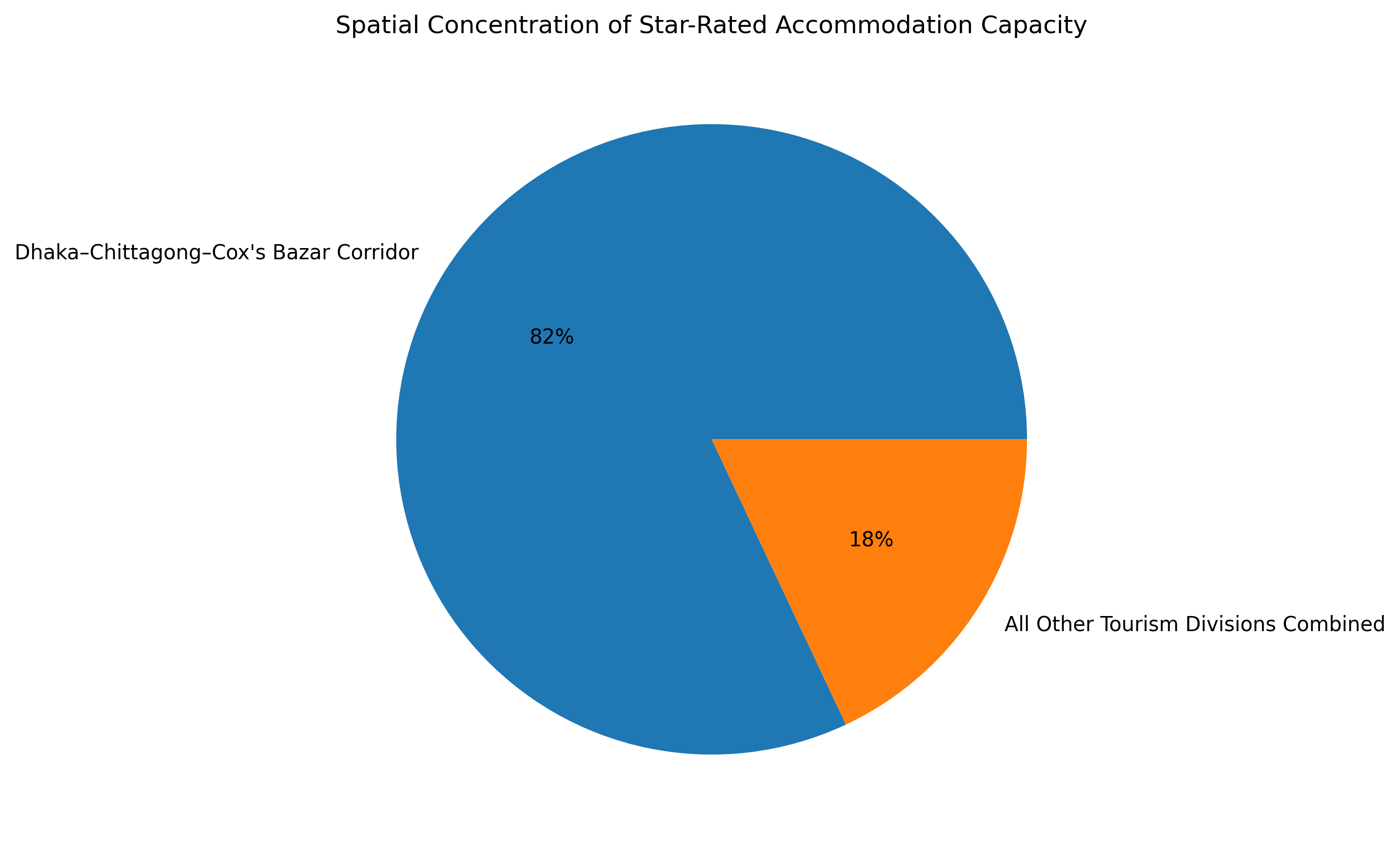
Diagram 2: Spatial Concentration of Star-Rated Accommodation Capacity
This structural concentration generates an acu te carrying capacity crisis. During peak tourism seasons (December–February), Cox’s Bazar experiences an influx that exceeds its structural carrying capacity by an estimated 250%.
This manifests in severe localized inflation, critical strains on municipal fresh-water aquifers, and raw sewage discharge entering the marine ecosystem. Conversely, high-potential archaeological zones like Paharpur (Naogaon) or Kantajew Temple (Dinajpur) cannot sustain multi-day international tour groups due to a near-total absence of premium, secure accommodations within a 50-kilometer radius.
4.4 The ICT Paradox
In contrast to physical infrastructure deficits, the digital ecosystem of Bangladesh represents a significant structural asset ($V_{ID} = 3.9$).
The widespread adoption of Mobile Financial Services (MFS)—specifically bKash, Nagad, and Rocket—has democratized transaction processes within the tourism sector. Over 94% of tourist-centric geographic zones are covered by 4G/5G cellular networks. This digital architecture allows micro-tourism entrepreneurs (e.g., local boat operators in Kaptai Lake or eco-guides in Sreemangal) to interface directly with domestic consumers, bypassing traditional, exploitative intermediary agencies.
5. Discussion and Structural Analysis
The empirical data reveals that Bangladesh's tourism infrastructure is trapped in a "Linear Expansion vs. Systemic Lag" cycle. While the primary transportation macro-networks have been rapidly modernized via centralized state spending, the localized micro-infrastructure required to convert transit networks into functional tourism ecosystems has lagged behind.
Applying Butler’s TALC Model, Cox’s Bazar has prematurely entered the Consolidation phase, exhibiting signs of environmental saturation typical of the Stagnation phase, without ever achieving a mature, high-yield international profile. The lack of integrated zoning laws has allowed speculative real estate developers to build concrete high-rises directly adjacent to the marine shoreline, causing irreversible visual and environmental pollution that deters high-spending international travelers.
Conversely, peripheral destinations like the Sundarbans (Khulna Division) remain artificially restricted to the Exploration or Involvement stages. The infrastructure deficit here is qualitative; there is an absence of specialized, low-emission eco-vessels, deep-water docking facilities, and rapid emergency medical evacuation networks (such as heli-ambulances). For international demographics, particularly retirees from OECD nations, the absence of high-tier trauma centers and emergency services within a 3-hour transit radius acts as an absolute deterrent to entry.
Furthermore, the institutional framework governing tourism infrastructure shows significant fragmentation. Infrastructure development in Bangladesh is managed across isolated ministries: highway networks fall under the Roads and Highways Division, rail under the Ministry of Railways, hotel zoning under the Ministry of Housing and Public Works, and tourism promotion under the Ministry of Civil Aviation and Tourism (MoCAT). In the absence of a centralized, cross-ministerial authority, infrastructure execution remains disjointed, lacking a cohesive master-plan perspective.
6. Strategic Policy Recommendations
To transition Bangladesh from a low-yield domestic tourism destination to a highly competitive international tourism hub, the following empirical, structural policy measures are required:
6.1 Creation of Special Tourism Investment Zones (STIZs) via Public-Private Partnerships
The government must move away from pure public funding models and aggressively utilize Public-Private Partnership (PPP) frameworks to build out the accommodation sector.
Special Tourism Investment Zones (STIZs) should be established in peripheral regions (e.g., Kuakata, Nijhum Dwip, Tanguar Haor). Private investors in these zones should receive a structured fiscal incentive package, including a 10-year corporate tax holiday, full duty exemptions on imported capital hospitality equipment, and accelerated land-acquisition clearances.
6.2 Deployment of Decentralized Sustainable Micro-Infrastructure
To preserve eco-sensitive zones while expanding economic monetization, the state must mandate sustainable infrastructure standards:
- Off-Grid Eco-Lodges: Implement strict building codes requiring solar-hydrogen hybrid power integration, zero-waste discharge systems, and the utilization of local, low-carbon building materials in the Chittagong Hill Tracts and Sylhet.
- Municipal Waste Interventions: Establish dedicated, automated solid waste recycling and effluent treatment plants (ETPs) exclusively for the Cox’s Bazar and Saint Martin’s Island hotel clusters, funded by a localized, progressive "Tourism Green Tax" levied on overnight hotel stays.
6.3 Institutional Realignment and Digital Twin Integration
It is highly recommended to establish a high-powered National Tourism Infrastructure Development Authority (NTIDA) operating directly under the Prime Minister’s Office. The NTIDA would possess the statutory power to override inter-ministerial gridlocks and synchronize infrastructure execution.
Furthermore, the state should develop a "Digital Twin" predictive mapping platform of the country's primary tourism zones to model real-time visitor density, transport congestion, and resource consumption, allowing for dynamic crowd management and infrastructure deployment.
7. Conclusion
The empirical assessment conducted in this study demonstrates that while Bangladesh possesses an exceptional inventory of natural and cultural assets, its commercial realization is heavily constrained by structural infrastructure deficiencies. The recent completion of transport mega-projects has effectively reduced geographical friction and catalyzed domestic tourism demand, but it has also exposed deep spatial asymmetries and a critical shortage of localized ancillary support services.
To avoid the pitfalls of over-tourism in primary hubs and stagnation in peripheral zones, Bangladesh must shift its policy focus from uncoordinated, volume-driven expansion toward structured, sustainable, and decentralized infrastructure development. By building strong public-private partnerships, implementing strict environmental zoning laws, and utilizing its highly advanced digital payment ecosystem, Bangladesh can transform its tourism sector into a highly resilient and competitive driver of its macroeconomic future.
Bibliography
- Ahmed, Z. U., & Krohn, F. B. (1992). Reversing the strictures of international tourism marketing in developing countries: The case of Bangladesh. International Marketing Review, 9(4), 35-49.
- Bangladesh Bureau of Statistics (BBS). (2025). Statistical Yearbook of Bangladesh. Dhaka: Statistics and Informatics Division, Ministry of Planning.
- Bangladesh Tourism Board (BTB). (2024). Strategic Master Plan for Bangladesh Tourism Development (2020–2040). Dhaka: Ministry of Civil Aviation and Tourism.
- Butler, R. W. (1980). The concept of a tourist area cycle of evolution: Implications for management of resources. The Canadian Geographer / Le Géographe Canadien, 24(1), 5-12.
- Dwyer, L., & Kim, C. (2003). Destination competitiveness as a determinant of economic growth: A theoretical and empirical framework. Journal of Tourism Research, 41(3), 343-365.
- Gunn, C. A. (2002). Tourism Planning: Basics, Concepts, Cases (4th ed.). New York: Routledge.
- Hasan, M. M., & Islam, M. S. (2021). Tourism destination competitiveness of Bangladesh: An analysis based on the Porter's Diamond Model. Journal of Hospitality and Tourism Management, 48, 112-123.
- Jani, D., & Mwombela, S. (2018). Infrastructure and its impact on tourism destination competitiveness: A structural equation modeling approach. African Journal of Hospitality, Tourism and Leisure, 7(2), 1-15.
- Khadaroo, J., & Seetanah, B. (2008). The role of transport infrastructure in international tourism development: A gravity model approach. Tourism Management, 29(5), 831-840.
- Khaled, N. (2019). Structural bottlenecks in South Asian tourism economies: A comparative review. South Asian Economic Journal, 20(3), 245-263.
- Porter, M. E. (1990). The competitive advantage of nations. Harvard Business Review, 68(2), 73-93.
- Rahman, M. S., & Rashid, H. (2023). Mega-projects and economic transformation: Evaluating the tourism dividend of the Padma Bridge and Cox’s Bazar Rail Link. Bangladesh Development Studies, 46(1), 57-82.
- Seetanah, B., Juwaheer, T. D., Lamport, M. J., & Sannassee, R. V. (2011). Does infrastructure matter in tourism development? An empirical analysis. Foreign Trade Review, 46(2), 89-108.
- Sultana, S., & Islam, N. (2015). Eco-tourism infrastructure adequacy in the Sundarbans mangrove forest: Stakeholder perspectives. Environmental Management and Tourism, 6(2), 341-355.
- World Economic Forum (WEF). (2024). The Travel & Tourism Development Index 2024: Realities of Recovery. Geneva: World Economic Forum.